
Elevate Your Scrabble Skills
Master the Game of Word Duel
Join us at NiCok Fun Challenge, where we transform your love for words into a competitive edge. Dive into our Word duel lessons designed for every skill level, and become a champion in no time!
Beginner's Guide to Word Duel
Getting Started with Word Duel
NICOK FUN CHALLENGE ONLINE GAMES:
Word Duel is a two-player word game on a 15×15 board. You build words from seven tiles, score for the letters and the squares you cover, and refill from the bag. It is not Scrabble, and the differences matter.
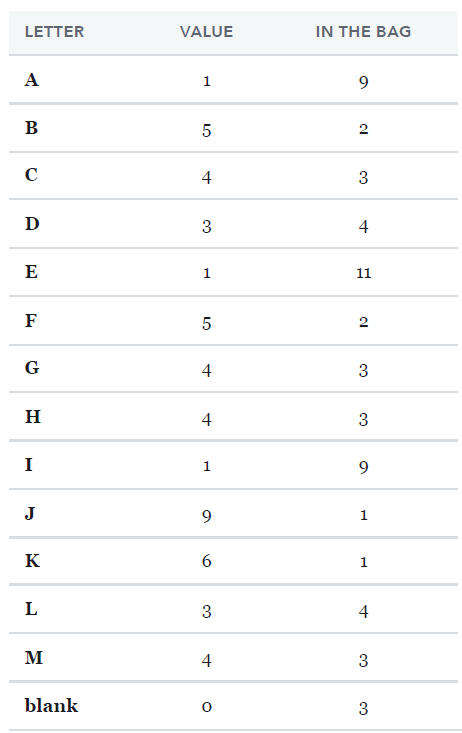
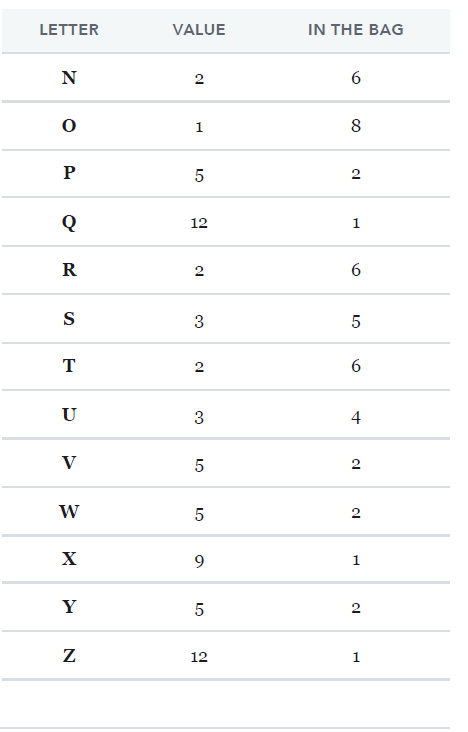
The board layout is uniquely different, the bag holds 104tiles rather than 100, and most letters are worth something different therefore, do not play from memory of another game. The premium squares are in different places and the letter you think is worth "8" probably is not.
Everything you need is in this manual, including the full board map and the value of every tile.
Before You Play
- You need to be a member to play.
- Anyone can watch a public match, but only signed-in members can take a seat and place a tile.
- Every match is a scheduled fixture; with two seats First and Second, a name, and usually a kick-off time. For a tournament, the organiser creates the match and seats both players, so you may simply find yourself already in it.
- Taking a seat: If a seat is free, click Take a seat. If both are already filled, you are already a player and the board will say so.
- The kick-off time: A match cannot be played before its appointed time, even with both players present. The board tells you when it begins, and starts accepting moves by itself when the time comes. There will be no need to reload.
What You See on Your Screen
Two seat cards: The players, with the running score for each.
A green dot: That player is at the board right now.
The status line: Whose move it is, or what the board is waiting for.
Your rack: Your seven tiles. Only you can see them.
The board: Click a tile, then click a square.
Moves: Every turn played, in order.
Nobody can see your rack not your opponent, not the spectators. The order of the bag is hidden from everyone too.
What everyone can see is how many tiles are left in the bag and how many each player is holding. Same things you could count at a real table. Late in a game, if the bag is empty and your opponent has two tiles left, they are two turns from going out.
Taking A Turn
You have three options on your turn: play a word, swap tiles, or pass.
Playing a Word
Click a tile on your rack to pick it up, then click the square you want it on. Repeat for as many tiles as you want to place. Nothing is sent until you commit, so you can take tiles back and rearrange freely.
The rules the board enforces:
- All your tiles go in one row or one column, with no gaps in the word you make.
- The very first word of the game must cover the star in the middle, and must be at least two tiles long.
- Every word after that must touch something already on the board.
- Every word you form must be in the dictionary; the one you meant, and every cross-word your tiles create as a side effect.
About the Dictionary
Word Duel uses ENABLE, an open word list of about 168,500 words. There are no challenges in Word Duel, and you cannot play an invalid word. The board checks every word the moment you commit and simply refuses the turn, telling you which word it did not recognise. Nothing is lost. Your tiles come back and you try something else.
This is a deliberate difference from playing at a table. A challenge system exists in paper word games because there is no dictionary at the table. Here there is one, so a wrong word costs you nothing but a rethink.
Blanks:
There are three blanks in the bag. A blank can stand for any letter, and you choose which when you place it. A blank is always worth zero, even on a double-letter square, but the word multipliers still apply to the word it is part of.
Swapping tiles
If your rack is unhelpful you can swap any number of tiles instead of playing. Your turn ends and you score nothing. You can only swap if the bag has at least as many tiles as you want to swap. Swapped tiles go to the back of the bag, so you will not immediately draw the same ones back.
Passing
You may pass without doing anything. It scores nothing, and see later sections, because passing repeatedly is one of the two ways the game ends.
“Your opponent moved. Board updated.”
Not an error:
You both committed at nearly the same instant and theirs arrived first. The board redraws and you take your turn again. Any tiles you had staged are returned to your rack, because the board underneath them has changed.
SCORING
The order matters, and it is worth understanding because it is where the big scores come from.
1. Letter premiums first: A tile on a double-letter or triple-letter square is worth 2× or 3× its ownvalue.
2. Add up the word.
3. Then the word multipliers: A word covering a double-word square scores double; a triple-wordsquare, triple. If you cover two, they multiply together two double-words is four times the word, not three.
4. Every cross-word is scored separately, and it gets the benefit of the same premium squares you just covered.
5. Using all seven tiles in one turn scores a bonus of 40, added last so the bonus itself is nevermultiplied.
A premium square only counts on the turn a tile lands on it. Once covered, it is spent for the rest of the game.
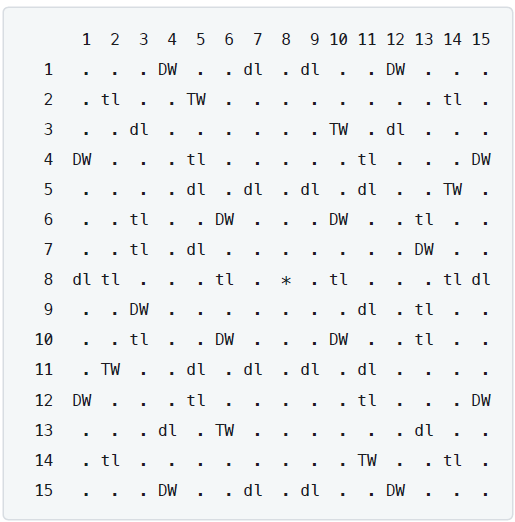
The Board
dl __ double letter,
tl __ triple letter
DW __ double word,
TW __ triple word
* __ the start square
The star carries no multiplier. It marks where the first word must go and nothing more. Opening on it does not double anything.
Note the triple-word squares: there are only six, none of them in a corner or on the centre row or column, and none close enough to the middle for an opening play to reach. They are worth planning several turns ahead for.
The tiles
104 tiles, including three blanks.
How the game ends
There are exactly two ways, and the board works it out for itself.
Someone plays out
One player uses their last tile while the bag is empty. They add the value of every tile still on theiropponent’s rack to their own score, and their opponent has that same amount deducted. Going out is worth a great deal. Holding a Q or a Z at the end is expensive twice over.
Nobody can move
Six scoreless turns in a row three each, ends the game. A scoreless turn is a pass or a swap. At that point both players have the value of their own remaining tiles deducted. Then the higher score wins Equal scores are a draw.
A final score can be negative.
If you are left holding expensive tiles that is simply what happens, and itis not rounded up to zero otherwise hanging on to a Z would cost nothing.
Resigning
Resign is always available while a match is live. It ends the game immediately and your opponent wins, whatever the scores are. It cannot be undone.
There are no clocks
No per-move time control. Two long backstops exist so a match cannot sit unfinished forever: If it is your move and you do not move for three days, you forfeit.
If a seat is still empty a short while after kick-off (usually fifteen minutes), the player who turned up wins by default.
There is no draw by agreement: A draw has to arrive on the scores.
Points
Winning a match earns points toward your NiCok total, shown on the leaderboard. How many depends on the game, and the organiser sets it. A typical setup is fifteen for a win, five for a draw and nothing for a loss. These are match points and have nothing to do with your word score; a narrow win is worth exactly as much as a wide one.
- A tournament tie does not pay match points. It scores through the tournament’s standings, so awin counts once, not twice.
- Winning because your opponent did not show up usually pays nothing.
Watching and sharing
The replay controls under the board step through the whole game one turn at a time. Racks stay hidden in a replay, exactly as they were during play.
If the match is public, anyone can open its page. If it is members-only, the link from your own match page carries a viewing key, so anyone you send it to can watch without signing in.
If something looks wrong
“… is not in the dictionary.”
One of the words you made is not on the list. It names the word it rejected. Your tiles are still yours.
“Tiles must go in one row or one column, with no gaps.”
You have placed tiles that do not form asingle unbroken line.
“A word has to touch what is already on the board.”
Your word is floating. Every word after thefirst must connect.
“The first word has to cover the star.”
The opening word must cross the centre square.
“There are not enough tiles left in the bag to swap.”
The bag is nearly empty. Play or pass instead. My staged tiles disappeared. Your opponent played while you were building. The board changed underneath your tiles, so they came back to your rack.
The page reloads on its own.
A signed-in session expires after a day or so, which an overnight match will outlive. Nothing is lost.
GOOD LUCK !!!||
PLAY WELL...
Join the Word Duel Tournament Today!
Don't miss out on the excitement! Sign up for our upcoming Word Duel tournaments and become part of the vibrant NiCok Fun Challenge community. Whether you're a seasoned pro or just starting out, there's a place for you. Compete, connect, and climb the ranks. Register now and let the wordplay begin!